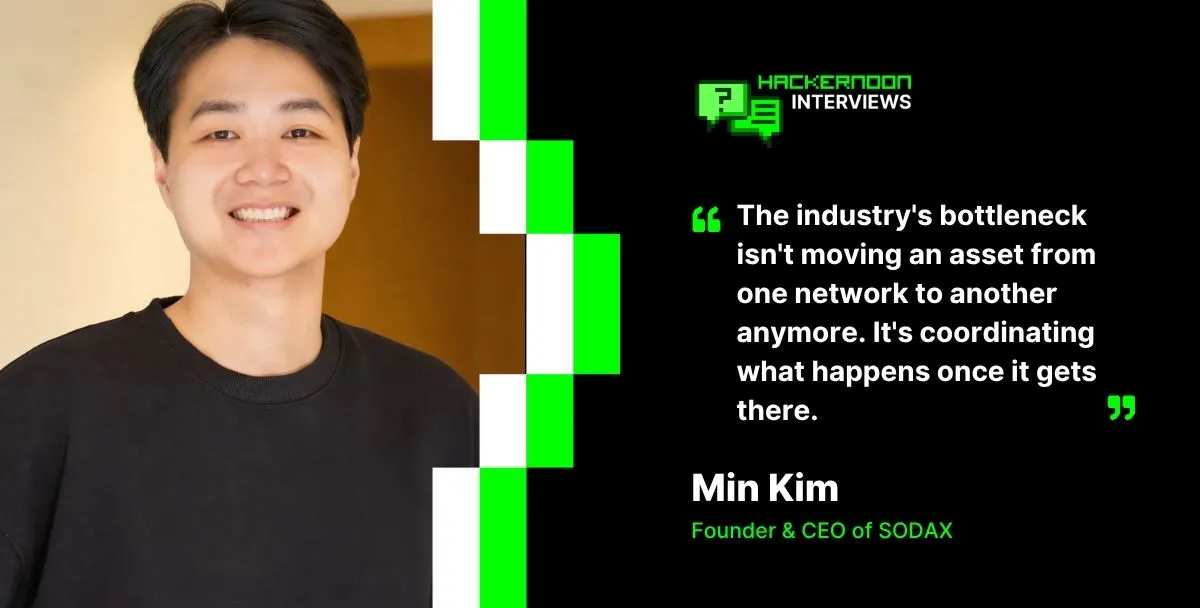
HackerNoon sat down with Min Kim, Founder & CEO of SODAX, to talk about the journey from building ICON to launching SODAX, the lessons learned along the way, and why he believes the future of finance lies in programmable, intent-based infrastructure. He shares how SODAX is helping developers integrate tokenized assets like xStocks and build cross-chain financial applications without the usual complexity. The conversation also explores the convergence of DeFi and traditional finance, the growing role of tokenized real-world assets, and Min's vision for making blockchain infrastructure so seamless that users never have to think about what's happening under the hood.
1. What inspired you to start the company, and what gap did you see that others weren't solving?
ICON started in 2017, when almost no infrastructure existed. We came out of the enterprise blockchain space, helping large organizations understand the technology, and the problems we kept hitting were scalability and interoperability. Interoperability is the one we never stopped chasing.
We made some calls that didn't pan out. We bet on Java instead of Solidity because we doubted Solidity would be adopted in Korea, and when DeFi Summer hit in 2021, EVM ecosystems compounded faster than anything we could match on a non-EVM chain. We got it wrong, and I'll own that.
What we got right was everything underneath: the mainnet, wallet, explorer, DeFi primitives, and interoperability, all built ourselves, the hard way. That experience became our asset. Two years ago we asked what we'd build if we started over knowing what we know now. Running a layer 1 is expensive, and there are now plenty of good teams doing that job, so we stopped and kept the layer where we had real expertise: execution and settlement. The industry's bottleneck isn't moving an asset from one network to another anymore. It's coordinating what happens once it gets there. That gap became SODAX.
2. What does "modern money" mean to you today, and why do you believe the boundaries between crypto and traditional finance are disappearing?
Modern money is money in programmable, multi-network systems, where its usefulness depends on execution, timing, and context, not just who holds it. Think of SODAX as a central securities depository, but on-chain and spanning many networks: closer to the settlement systems banks rely on, like the IMF's Special Drawing Rights, or the tokenized-deposit networks lenders use to clear payments among themselves.
The boundary between crypto and TradFi is disappearing because the underlying problem is the same: moving and settling value with trust, speed, and low cost. Finance is heavily regulated because it's a trust layer, and a DeFi vault can encode those same rules into the program itself. The manager can't take the money and run, and the balance is verifiable on-chain instead of needing a separate auditor. That's lower cost and higher safety at once, and it's already happening. I see it in meetings with Korean financial institutions, many of which are quietly building DeFi and self-custody products of their own.
3. SODAX recently integrated xStocks into its SDK. What does this milestone unlock for builders, and why is it important for the ecosystem?
We added xStocks, tokenized versions of stocks like Tesla, Nvidia, Circle, MicroStrategy, Coinbase, and Google, into the SODAX SDK. Any customer using our SDK can now offer xStocks to their users from any of our 20 integrated networks, without touching Solana directly, where xStocks settle natively. Intent-based execution then sources the liquidity, coordinates execution, and settles the trade. The user just sees a normal swap.
Bound Exchange was our initial partner integration for these assets, which they requested specifically to offer direct swaps against native Bitcoin. While initially built into our infrastructure for
4. How do you see tokenized real-world assets evolving over the next few years? Could they become as fundamental to DeFi as stablecoins are today?
It's already heading that way. We're actively looking for unique real-world assets you can't find represented anywhere else. We've been scouting some in Korea that I won't confirm yet, but the direction is clear. On the institutional side, I expect a wave of stock-based and ETF-based tokens, and our job is making sure those assets can move freely across whichever network they need to reach.
Will RWAs become as foundational as stablecoins? I believe so. Stablecoins won because they gave crypto a stable unit of account people could actually use. Tokenized RWAs give crypto exposure to value people already understand and want to hold, without forcing them to learn a new asset class. Stack verifiable data on top of that and you get a flywheel: more customers, more volume, more growth. The value proposition is clear. It's a matter of time.
5. Rather than building a consumer-facing app, SODAX chose to empower developers. Why do you believe infrastructure is the most effective way to accelerate innovation?
This is something we struggled with early on: B2C, B2B, or some mix. The question we kept coming back to was where we could make the most impact and reach the most people. The DeFi experience today is clunky. You're clicking approve, approve, approve across sequential transactions, and if something breaks halfway, your money is stuck and you have to go find it.
Infrastructure is the leverage point. Without AWS, every internet company would have had to build its own infrastructure from scratch. With SODAX, a builder can launch an app quickly without learning on-chain plumbing from zero. We abstract away the approval flows so the experience is clean for the user, and that lets the builder focus on their product instead of stitching together five different tech stacks. One team building good infrastructure can multiply the output of hundreds of teams building on top of it.
6. What's the biggest challenge developers face building cross-chain financial applications today, and how does SODAX simplify that?
The biggest challenge is that going cross-network has meant learning every network you want to support, then solving liquidity fragmentation on top of that. If you issue a token on Ethereum and want it tradable elsewhere, you have to seed liquidity again on every new network. On the user side, moving value across networks meant a sequence of manual steps: bridge, swap, bridge again, approving each one and troubleshooting by hand if it got stuck.
SODAX collapses that into unified liquidity and intent. You add liquidity once, and it's tradeable across every network we support. Builders and users state the outcome they want, as if they are setting a destination in a ride-share app, and solvers coordinate the routing underneath these intent-based trades. Transactions are atomic: they either complete in full or refund in full, so nothing gets stuck halfway.
7. How do you see programmable finance helping expand access to opportunities traditionally limited by geography or financial infrastructure?
Programmable finance removes the need for access to run through a local bank, broker, or regulator's timeline. Once an asset and its rules are encoded in a program instead of an institution's back office, geography stops being the gatekeeper, the same way a builder anywhere can spin up on AWS without asking permission from a data center down the street.
SODAX adds that the asset doesn't have to be trapped on one network either: liquidity and execution work the same whether a user starts from Solana, an EVM network, or somewhere else. The two barriers that have traditionally limited financial access, where you live and which network your money sits on, we would like to lower both of these barriers at once.
8. Five years from now, what do you hope the financial ecosystem looks like, and what role do you hope SODAX has played?
This is a question I wrestle with daily: whether blockchain becomes core infrastructure or stays a speculative niche. My honest read is that the paradigm-shifting infrastructure hasn't fully arrived, but the signs are good. Self-custody is getting easier to use, stablecoins are folding into daily life, and I've had enough conversations with traditional financial institutions to know they see the same shift coming and are quietly preparing for it.
Five years from now, I'd like a builder anywhere to launch a cross-network financial product the way they'd spin up a payment gateway for online shopping today, without becoming an expert in five different blockchain networks first. If SODAX has played its part, our cross-network volume keeps compounding the way it has since launch, roughly doubling month over month, and the architecture becomes invisible, the way good infrastructure always does.
9. What advice would you give to founders and developers building the next generation of financial applications today?
I've been through countless up-and-down cycles, and I don't think the market is the problem right now. It's more stable than it used to be. Institutions are investing, financial firms are preparing, and builders keep building regardless of price.
Warren Buffett's point stays with me: markets always swing, but the underlying value is higher than it was a year ago, five years ago, ten years ago. The AI boom looks the same in hindsight. People think it happened overnight, but I was hearing about AI twenty years ago in banking, and OpenAI researched for a decade before ChatGPT landed. The internet got written off as a bubble before YouTube and Facebook showed up, more than a decade in. Don't confuse the tipping point not having arrived yet with the thesis being wrong. Every credible expert, VC, and financial institution I talk to sees what I do: this technology is simply better than the financial infrastructure we have now.
10. Where can readers follow SODAX's journey, and what's next for the team?
The best place to follow along is
As for what's next, the metric I care about most is cross-network volume, which has been growing steadily since launch. We have several strategies to keep pushing it higher, with unique real-world assets being just one of them. We’re actively scouting assets you can't find represented anywhere else and xStocks was one recent step in that direction, with more asset coverage coming.